
Viticultural technical assistance
10 November 2015

From waste energy, ViEnergy in Rimini
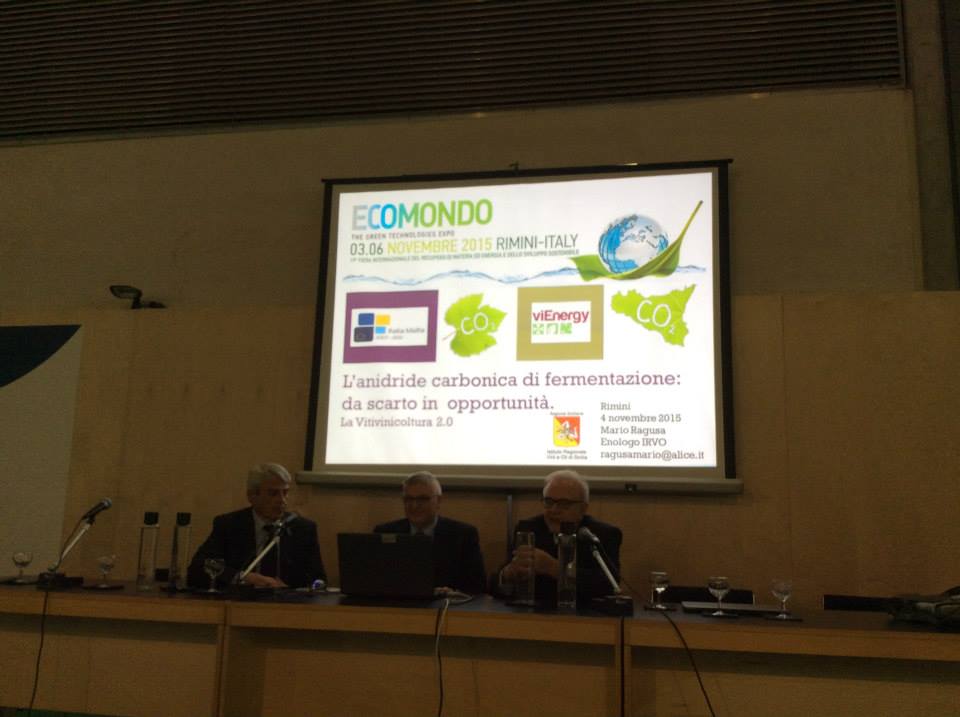 Sustainable production where waste becomes energy. This is what was discussed during the workshop organized by the Regional Institute of Wines and Oils of Sicily with the collaboration of ENEA and Legacoop Agroalimentare della Sicilia and which took place in Rimini,
on November 4, within the conference "Innovation and research for green agriculture: collaborating to cooperate" at Ecomondo. A workshop that saw alternating interventions by several experts in the sector coordinated by Antonello Pezzini, representative of the European Economic and Social Committee. Among these, the oenologist Mario Ragusa of IRVO and Andrea Capriccioli, ENEA researcher, who focused in particular on the presentation of the results of the ViEnergy project. Project financed with community funds from the Italy-Malta OP 2007-2013, on the use of wine by-products as raw materials for green energy.
“The results of the project – comments Ragusa – have demonstrated that a very important concept, that of “Wine Goes Green”, is possible and achievable. The use of renewable energy in the production, conservation and transport of wine, but also the procurement of recyclable materials used for packaging, the choice of organic cultivation methods and healthy lifestyles, constitute the approach for the future ”. The spotlight was therefore focused during the workshop on the topics of CO2 reduction and sustainable agriculture: "The notable opportunities presented by the segment of use of by-products in terms of of decarbonisation from fossils and economic recovery of raw materials". The possible contribution of the wine sector to the topic of decarbonisation and climate change was thus addressed, which is highly topical and in perfect harmony with the COP21 on the climate which will be held in December 2015 in Paris. The ViEnergy project further improves this relationship through the transformation of the CO2 itself into biomethane and therefore sets the objective of creating a plant for the recovery of the CO2 emitted by the winemaking cycle. “Hydrogen can come from any source, first and foremost its production with electricity deriving from renewable energy sources. – explains Capriccioli – CO2 can be filtered from any climate-altering emissions: in particular, highly pure CO2 can be obtained from the fermentation of the must. Laboratory analyzes confirmed the complete methanation of the fermentation CO2 obtained from the IRVO”. The methanization tests carried out at the Roma 3 University in collaboration with prof. Luisetto to its possible use in the winery production cycle, in the food industry, in cooling processes and for the transformation into methane via the Sabatier reaction. Moving on to analyze the implementation of a pilot project for the methanization of CO2, Sergio Mantovani illustrated the great work carried out both in terms of the technologies used and the research of the materials, as well as the analyzes carried out on their gas permeability in order to guarantee maximum safety in the conversion process. “The project – concluded Biagio Bergesio of Legacoop Agroalimentare – could become an excellent viaticum for creating value both in economic and environmental terms. The importance of the wine sector is significant within the Association which brings together, at a national level, 80 wineries, with a turnover of around one billion euros per year and therefore, if technology guarantees a satisfactory cost-benefit ratio, it does not distract companies from their institutional role of producing good wine and does not represent any danger in terms of safety".
Ultime notizie
News January 30, 2026
Duties assigned and authorized to employees
List of tasks authorized in the year 2026 EMPLOYEE SUBJECT OF THE TASK DURATION GROSS COMPENSATION Rosario Geraci Cleaning services all locations DDG liquidation of technical incentives: n.
News 9 January 2025
Public consultation on the IRVO 2026-2028 PTPCT update
Public consultation for the update of the Three-Year Plan for the Prevention of Corruption and Transparency (PTPCT) 2026/2028. In order to allow maximum involvement in the preparation of the update of the Three-Year Plan for the Prevention of Corruption and Transparency of the Regional Institute of Wine and Oil for the three-year period 2026/2028, all interested parties – particularly citizens, companies, consumer associations, representative trade unions, and other entities operating in the territory representing particular interests – are invited to submit comments and/or proposals to the Head of Corruption Prevention and Transparency (RPCT), which will be evaluated during the drafting of the document.
 English
  Italian